


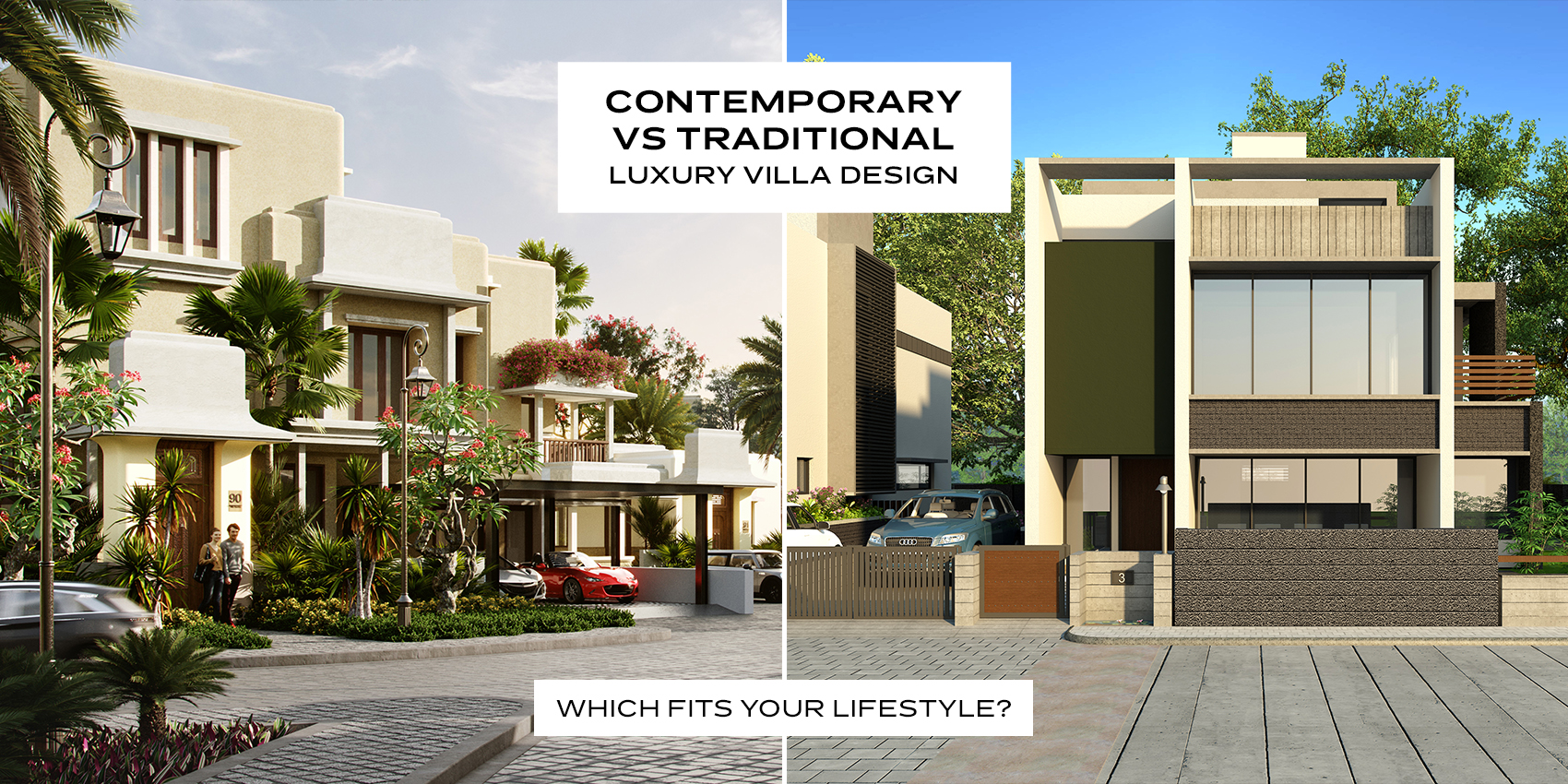
There is a question that quietly follows every serious homebuyer. Not about location. Not about price. But about design language.
Do you want a home that feels rooted, one that carries the weight of heritage and the warmth of things built to last? Or do you want something clean, forward-looking, a space that breathes and moves with the way life is lived today?
The honest answer, for most people, is neither. Or rather, both.
What We Mean by Traditional Luxury Villa Design
Traditional luxury villa design draws from cultural memory. It leans into craftsmanship. Stone that has been shaped by hand. Proportions inherited from architecture that stood for centuries. Materials chosen not for efficiency, but for presence.
In the Indian context, this lineage runs deep. Think of the stepwells of Gujarat, built not merely as infrastructure, but as layered civic art. Think of the Pol neighbourhoods of Ahmedabad: intricately carved wooden facades, internal courtyards that controlled light and airflow, homes designed around community and hierarchy at once.
Traditional design at its finest is never simply decorative. It is structural thinking informed by climate, culture, and the long arc of how people have chosen to live in a particular place.
The risk, when done poorly, is that it becomes pastiche. Ornament without meaning. Elements borrowed from one era and grafted onto another without understanding why they existed in the first place.
What Contemporary Luxury Villa Design Gets Right
Contemporary design strips things back. It privileges openness. Light. The honest expression of materials: concrete, glass, steel, natural stone used in their most direct form.
It is also, at its best, deeply rational. Contemporary luxury villa design solves for how life actually works: open-plan living, the integration of indoor and outdoor space, rooms that shift function across the day, service and privacy separated with precision.
Where traditional design accumulates, layering ornament, texture, narrative, contemporary design subtracts. The quality of silence in a room. The way light changes across a stone floor over the course of a morning.
The risk of contemporary design done without care is sterility. Spaces that photograph beautifully but feel cold to inhabit. Luxury as aesthetic rather than experience.
Why the Strongest Homes Today Are Neither One nor the Other
The conversation has moved on from the binary.
The homebuyers choosing luxury villas today are not making an either-or decision. They want spaces that carry meaning but live efficiently. They want the warmth of craftsmanship and the clarity of modern planning.
This is not a compromise. When the thinking is right, it is a third thing entirely. A design vocabulary that uses heritage as a starting point and builds something new with it.
Bill Bensley, internationally acclaimed designer behind Le Parque by Gala, frames it this way: all of his work is about extending the culture and heritage of a place, never importing an aesthetic that belongs elsewhere. The design for Le Parque by Gala draws directly from Pol architecture, the historic urban fabric of Ahmedabad. But it does not reproduce it. It reinterprets it, taking the structural logic, the courtyard sensibility, the relationship between built form and open space, and translating those principles through a contemporary design lens.
The result is a home that feels of this place without being frozen in it.
How to Think About Design Language When Choosing a Luxury Villa
The question is not really contemporary versus traditional. The more useful question is: what kind of daily experience does this design produce?
A home with a strong traditional character may ask you to slow down. To notice. It rewards presence. There is always something to discover: a detail in the stonework, the way a courtyard shifts in quality of light across seasons.
A home with a strong contemporary character asks you to move through it with ease. The openness is a kind of hospitality. It does not direct you; it makes room for you.
Homes that hold both, grounded in heritage but rigorous in their spatial thinking, tend to produce the deepest satisfaction over time. They do not tire. They do not date.
The Le Parque by Gala Approach
At Le Parque by Gala, spanning 300 acres outside Ahmedabad, the design philosophy begins with place. Not with trend.
The master plan draws on the Pol tradition, not its visual vocabulary directly, but its underlying logic: the relationship between private and collective space, the integration of landscape and built form, the idea that a community should be legible, navigable, and rich with human detail.
Within that framework, the interiors engage with modernist art and mid-century design influence, an exercise in experimentation that gives each neighbourhood within the estate its own distinct character, while holding to a single coherent idea about what luxury should feel like.
The craftsmanship is Indian and Bensley has been unequivocal about this: the Indian craftsman working in stone is among the finest in the world. That skill, that knowledge of material, is woven into the surfaces of Le Parque by Gala in a way that no imported aesthetic could replicate.
The result is not a look. It is a conviction. That design which extends a place’s heritage is design that endures.
The Question Worth Asking
When you stand inside a home and ask yourself whether it is contemporary or traditional, you are probably asking the wrong thing.
The right question is simpler.
Does this feel true to where it is? Does it feel built for how I intend to live? Does it have the quality, in material, in proportion, in spatial generosity, that I will still value twenty years from now?
If the answer is yes, the label never mattered.
The homes that endure are rarely the ones that committed fully to one camp. They are the ones where the designer understood something deeper: that people do not live in styles. They live in rooms. They live in light. They live in the quality of a morning, the feeling of an evening, the way a house holds the people inside it.
The most considered residential design happening today draws from both traditions without announcing it. Heritage becomes a structural instinct rather than a visual reference. Contemporary thinking becomes a spatial logic rather than an aesthetic choice. The two stop competing and start composing.
Le Parque by Gala sits somewhere in that conversation. Not as an argument for one side or the other, but as a home that began with the question of how people actually want to live, and let the design follow from there.